Symbols Overview
Eye of Horus remains one of the best-known Egyptian slots found at UK online casinos, blending a simple 5-reel layout with recognisable myth-inspired icons and bonus features. If you're searching for Eye of Horus symbols, this page breaks down exactly what each icon does, how the paytable is structured, and why the wild and scatter matter so much.
This guide is designed as a practical reference for UK players who want a clearer understanding of Eye of Horus pay symbols, Eye of Horus symbol values, and the slot's special mechanics before playing. While payout figures can vary slightly depending on the version or casino, the core symbol ranking and feature set stay very familiar across the most common releases.
On this page, you'll find:
- A full look at the Eye of Horus paytable and symbol hierarchy
- A clear explanation of the Horus wild symbol and how expanding wilds work
- Details on the scatter symbol, its payouts, and how it triggers free spins
- A breakdown of special symbols and bonus features, including free spins upgrades
Eye of Horus Slot Facts at a Glance
Before diving into the paytable itself, it helps to understand the base format of the slot UK players usually encounter. The classic Eye of Horus title is commonly presented as a Merkur / Reel Time Gaming-style Egyptian slot with a traditional setup and straightforward line-based gameplay.
| Item | Details |
|---|---|
| Game title | Eye of Horus |
| Developer | Commonly listed in UK reviews as a Merkur / Reel Time Gaming style release |
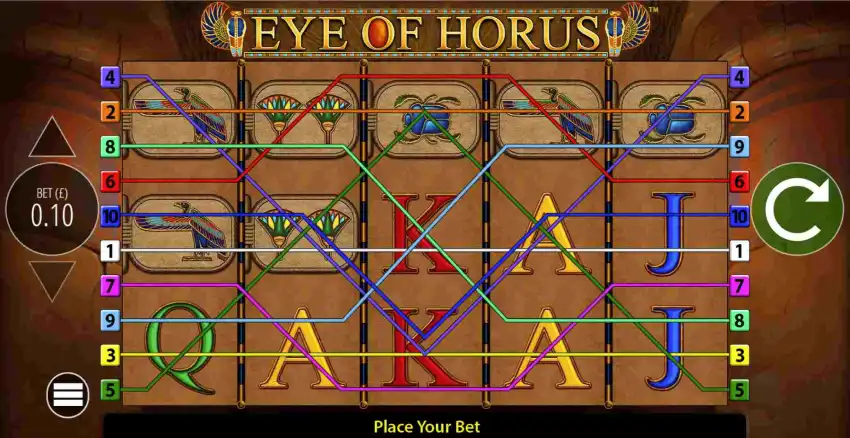
| Reels & rows | 5 reels, 3 rows |
| Pay structure | Fixed paylines in the classic version |
| Theme | Ancient Egypt, Horus mythology, temples and hieroglyphic imagery |
| RTP & volatility | Usually described as mid-90s RTP with medium volatility, depending on version |
| Highest regular symbol | Eye of Horus |
| Special symbols | Horus wild and temple/tomb scatter |
The classic version is built around a familiar Egyptian theme, with premium picture symbols, lower-paying royals, and a bonus round driven by scatters. The visual style usually includes golden frames, desert tones, and temple imagery, which reinforces the old-school feel that has helped the game stay popular for years.
It's also worth noting that Eye of Horus symbol values are stake-dependent. In other words, the amount shown in cash terms will change with your bet size. Even so, the key part of the paytable remains consistent: the Eye symbol is typically the most valuable regular icon, followed by Anubis, Falcon, Scarab, and the lower tiers beneath them.
Eye of Horus Paytable and Winning Symbols
The Eye of Horus paytable is based on standard left-to-right line wins. In the classic format, players usually need 3 or more matching symbols on an active payline, starting from the leftmost reel, to receive a payout. That makes the symbol order especially important, since premium icons can deliver significantly stronger returns than the lower-value royals.
Exact figures can vary between releases, bet levels, and UK casino platforms, so the values below are best treated as illustrative. What stays stable is the overall ranking of the symbols and the way wins are formed.
| Symbol | 3 of a kind | 4 of a kind | 5 of a kind | Relative value |
|---|---|---|---|---|
| Eye of Horus | High | Very high | Top regular payout | Highest |
| Anubis / Jackal | Medium-high | High | Very high | 2nd highest |
| Falcon | Medium | Medium-high | High | Upper-mid |
| Scarab | Medium | Medium-high | High | Upper-mid |
| Ankh | Low-medium | Medium | Medium-high | Mid value |
| Fan / Lotus fan | Low-medium | Medium | Medium-high | Mid value |
| A, K, Q, J, 10 | Low | Low-medium | Medium | Lowest |
In most versions, the hierarchy is clear: Eye of Horus symbol values sit at the top of the regular paytable, followed by Anubis, Falcon, and Scarab. Beneath those come the Ankh and fan symbols, while the card royals provide the most frequent but smallest line wins. For anyone comparing Eye of Horus pay symbols, that ranking is the main thing to remember.
Lower-Tier Eye of Horus Symbols and Their Payout Role
Not every win in Eye of Horus comes from the big Egyptian picture symbols. A large part of the game's rhythm comes from the lower and mid-tier icons, which tend to appear more often and contribute to the slot's medium-volatility feel.
Ankh and fan symbols
The Ankh and fan symbols usually sit in the mid-value tier of the Eye of Horus paytable. They don't produce the same kind of standout returns as Eye or Anubis, but they are important because they land more often and can create useful line wins across active paylines.
Typical illustrative values are often along the lines of:
- 3 of a kind: around 10x bet per line
- 4 of a kind: around 50x bet per line
- 5 of a kind: around 200x bet per line
These symbols help support regular gameplay by offering moderate payouts without needing the rarer premium combinations.
| Mid-value symbol | 3 of a kind | 4 of a kind | 5 of a kind |
|---|---|---|---|
| Ankh | Low-medium | Medium | Medium-high |
| Fan / Lotus fan | Low-medium | Medium | Medium-high |
A, K, Q, J and 10 card royals
The card royals are the lowest-paying Eye of Horus pay symbols, but they are also the ones players usually see most often. These symbols represent the familiar A, K, Q, J and 10, styled to fit the Egyptian theme.
Typical payout pattern:
- 3 matching royals usually deliver small wins
- 4 matching royals offer modest returns
- 5 matching royals can still produce a worthwhile payout, though well below the premium icons
In practical terms, these low-value symbols create more frequent, smaller wins and balance the slot's bigger premium and feature-driven payouts. So when players talk about Eye of Horus symbols, it's worth remembering that the paytable includes both the striking Egyptian picture symbols and the simple royal card icons that shape the base game flow.
Horus Wild Symbol: How It Works
What the Eye of Horus wild symbol does
In the classic game, Horus is the wild symbol. This is one of the most important special mechanics in the entire slot and a major reason why the game remains popular with UK players.
The Horus wild generally:
- Appears on reels 2, 3, and 4
- Substitutes for regular pay symbols
- Does not replace the scatter symbol
- Helps complete or improve winning combinations
This means the wild's value is less about a direct payout and more about how it transforms the reels around it. By stepping in for missing premium or lower-tier symbols, it can turn near-misses into actual wins and boost the value of existing combinations.
Expanding wild reels
The defining trait of the Horus wild is its expanding behaviour. When it lands in the base game, it often expands to fill the entire reel.
That expanding wild feature can:
- Turn a single wild tile into a full stacked reel
- Create multiple winning paylines at once
- Connect premium symbols across adjacent reels
- Raise the overall payout potential of one spin dramatically
This mechanic is central to the slot's identity. Even on a simple 5x3 layout, a full wild reel on reel 2, 3 or 4 can reshape the whole screen and unlock a much stronger result than a standard substitution would suggest.
Does the wild have its own payout?
In many classic versions, the Horus wild is mainly treated as a substituting and expanding feature rather than a symbol with its own standard paytable line value. That's why many players see it as the most important utility symbol rather than a direct-paying icon.
Its real value comes from completing high-paying combinations, creating stacked reel coverage, and increasing the number of winning lines in one spin. Some modern variants, including other Eye of Horus formats, may handle the wild slightly differently and can assign it its own payout function. But in the core classic version, substitution and expansion are what matter most.
Wild behaviour in free spins
The Horus wild becomes even more interesting in the bonus round. In many versions, its role during free spins goes beyond standard expansion and can include upgraded symbol behaviour or added bonus effects.
Players can often expect the free spins feature to make the most of the wild by improving lower-value symbols, helping form stronger premium combinations, and in some versions contributing to extra spins or enhanced outcomes.
That enhanced role is a big part of why the wild is one of the standout Eye of Horus special symbols rather than just another reel filler.
Scatter Symbol in Eye of Horus
What the scatter looks like
The Eye of Horus scatter symbol is usually shown as a tomb, golden door, or temple-gate style icon. It stands apart visually from the regular pay symbols and serves a dual purpose: it can award a direct payout and it triggers the game's free spins bonus.
Unlike normal line symbols, the scatter does not need to appear on a payline to count. Instead, it pays anywhere on the reels, provided enough of them land in the same spin.
Typical scatter payouts
The scatter often uses a 3, 4, or 5-symbol payout structure. As with the rest of the Eye of Horus symbol values, exact figures may differ slightly between operators and versions, but the format below is widely recognised.
| Scatter count | Typical payout (x total bet) |
|---|---|
| 3 scatters | around 20x |
| 4 scatters | around 200x |
| 5 scatters | around 500x |
Those payouts show why the scatter is more than just a bonus trigger. It can produce a meaningful return in its own right, especially when 4 or 5 symbols appear.
Why the scatter matters so much
The scatter is one of the key special symbols in Eye of Horus because it unlocks the game's feature round. Its main functions are:
- Pays anywhere on the reels
- Usually activates with 3 or more scatters
- Triggers the free spins bonus
- Adds extra value even when no line win is present
For many players, the scatter is the most exciting icon to land because it opens the door to the section of the game where symbol upgrades and expanding wilds can become much more rewarding.
How Special Symbols Shape the Bonus Features
Wilds and scatters have different jobs
Although both the wild and scatter are classed as Eye of Horus special symbols, they work in very different ways. The relationship is simple: the wild helps create or improve line wins, the scatter pays anywhere and triggers free spins, and the wild does not substitute for the scatter.
That separation keeps the game mechanics easy to follow. One symbol supports combinations, while the other activates the feature round.
Free spins and upgraded symbol values
In many popular versions of Eye of Horus, landing 3 or more scatters awards a set number of free spins, often 12 free spins. This is where the gameplay shifts from a straightforward line slot into something with more potential.
During free spins, the Horus wild may:
- Upgrade lower-paying symbols into higher-paying ones
- Improve the overall quality of symbols on the reels
- Increase the chance of forming premium combinations
- In some versions, award extra free spins
This is a major reason why the bonus round is often the highlight of the slot. When low or mid-value icons become stronger symbols, the Eye of Horus paytable effectively becomes more lucrative for the duration of the feature.
Other Eye of Horus versions in UK casinos
UK players may also come across alternative versions such as Eye of Horus Megaways and Eye of Horus Fortune Play. These games change the structure and can tweak the way special features behave, but they still retain the recognisable Egyptian symbol set and the core wild/scatter identity.
Common differences include:
- Megaways introduces changing reel heights and a ways-to-win system
- Fortune Play adds modified stake options and enhanced feature behaviour
- Symbol values and paytable details can differ from the classic release
Even in these variants, the fundamentals remain familiar: Horus is still the key wild figure, while the scatter still drives the bonus side of the game.
Understanding Eye of Horus Symbol Values in Play
The symbol hierarchy at a glance
When looking at the slot from a player's perspective, the easiest way to understand the paytable is through its hierarchy:
- Eye of Horus
- Anubis
- Falcon
- Scarab
- Ankh / Fan
- A, K, Q, J, 10
That order matters because it shapes the way wins tend to appear. The lower part of the table usually delivers smaller but more frequent returns, while the premium symbols carry most of the upside.
How wins typically build
Gameplay often rewards a mix of frequent smaller combinations from royals and mid-tier icons, plus less common but stronger payouts from premium symbols linked with expanding wilds.
In practical terms, players can expect the lower-value symbols to keep the reels active, while the bigger moments usually come from one of these scenarios:
- A premium 4 or 5-of-a-kind line
- A well-timed expanding wild on reels 2, 3, or 4
- A free spins round with upgraded symbol behaviour
That blend is one reason Eye of Horus is typically described as a medium-volatility slot.
What medium volatility means here
In descriptive terms, medium volatility usually means a balance between smaller and larger payouts, reasonably regular line wins from lower symbols, and the chance of occasional stronger hits through wilds and bonus play.
That does not guarantee any specific outcome, but it helps explain how the Eye of Horus symbol values translate into actual gameplay rhythm. The slot is not solely dependent on rare jackpot-style moments, nor is it built only around tiny steady wins. It sits somewhere in between.
Comparing Classic, Megaways and Fortune Play Versions
If you've seen different Eye of Horus games across UK casino sites, you may have noticed that the symbol set looks familiar even when the mechanics change. The table below highlights the main differences.
| Version | Reel setup | Payline/ways | Key high-value symbols | Wild symbol | Scatter symbol |
|---|---|---|---|---|---|
| Classic Eye of Horus | 5x3 | Fixed paylines | Eye of Horus, Anubis, Falcon, Scarab | Horus wild, usually expanding | Temple/tomb style scatter |
| Eye of Horus Megaways | Variable Megaways reels | Ways to win system | Variant-dependent premium hierarchy | Eye of Horus wild | Scatter triggers Megaways feature |
| Eye of Horus Fortune Play | Classic-style base with enhanced options | Line-based with modified stake/feature style | Familiar Egyptian premium set | Horus wild with expanding behaviour | Similar temple/tomb scatter |
The key takeaway is that exact symbol values may change from one version to another, but the core identity remains consistent. The Egyptian premium icons, the Horus wild, and the scatter-triggered bonus round are all part of the same recognisable formula.
Eye of Horus Symbols FAQ
Important Note on Paytable Values and Responsible Play
The payout examples on this page are intended as a helpful guide to the most common UK-facing versions of Eye of Horus. Because operators may host different releases or settings, exact symbol values can vary according to stake level, platform, and game format.
- Payout examples shown here are illustrative, based on commonly described versions
- Always check the in-game Eye of Horus paytable for exact symbol values
- Results are random, and there is no guaranteed strategy for winning
- This page is designed to explain Eye of Horus symbols, not to offer financial or betting advice
Used as a reference, this guide should make it much easier to understand what each symbol does, how the special features work, and which icons matter most when you open the game.